Sunday, January 22, 2012

Zanzibar Part 1: a Transportation Nightmare!

I feel like I've spent a week in a story book, or a history book to be more exact. The island of Zanzibar was more than what I could have expected from its mysterious name, and even more mysterious history. Although I was sad to spend my first Christmas away from my family, I had an amazing experience tasting, learning, and experiencing my way through East Africa's most popular island. But I'm getting ahead of myself...

I've learned that no journey in Malawi is complete without a ridiculous transportation story, and this holiday trip was no exception. A last-minute bus ticket purchase landed my friend and I the last two seats on the infamous Mohammed Taraq bus, known for insanely long, unstable trips between Lilongwe and Dar Es Salaam. We boarded at 7 pm on Christmas Eve, welcomed in the holiday with a yummy cream-filled raisin bun and a homemade juice concoction, and attempted to sleep for the remainder of the journey. An abrupt 4 am stop acted as a wake-up call: we were at the  Malawi-Tanzania  boarder (before border control arrived) and although no one bothered to share, we would be stuck there for a few hours. Two border checks, $100 visa, and about five hours later, we continued on what would become another 10 hour journey. English communication was a problem - bathroom stops (for women) were even more problematic - and the highly (and unpleasantly) aromatic, cockroach-ridden bus ride made arrival all the more exciting.

After a wonderful and relaxing week away - with thoughts of beaches fresh at hand - I experienced what I can honestly say was the worst transportation experience thus of my life. We bought a direct Dar Es Salaam to Lilongwe ticket, expecting a similar journey back; what we got was a never-ending nightmare. A 5 AM traffic jam started our morning, and for fear of missing the 6 AM bus, we hopped out in traffic with our luggage and ran! We arrived at the bus depot expecting to easily find the Mohammed bus, and instead spent almost half an hour running through a maze of what seemed like 100 busses. After thinking we'd lost our chance of getting back to Malawi, we found Emma (aka 50 cent), the guy who sold us our bus tickets. "There is a problem with the bus," he said, "Come. Take this one. He will take you to the border, where you will meet the Mohammed bus." The arrangement sounded questionable, I asked for more details, and after being told several to "relax, don't worry," I tried to do just that.

Within the first half hour, I'm told we experienced a flat tire that somehow I managed to sleep through. I woke up in time to get off and watch a lesson in how to change a bus tire before resuming what I soon learned would be a hellish ride. I don't think the word "airborne" properly describes my experience. We flew for the next considerable length of the journey, attacking Tanzania's three-in-a-row speed bumps like they were figments of my imagination. The thought that I was actually going to die crossed my mind several times, and so I spent the remainder of this leg of the journey sending goodbye messages, praying, and desperately rummaging through my first aid kit to find something that would make me sleep.

While I wish that were the end of the journey, it seemed the fun times were just beginning. After stopping in the middle of the road for sometime due to an overheated engine, we arrived at a bus depot an hour away from the border (and thus an hour away from where our bus was supposed to be waiting). I had asked several times about getting to our destination (to which I was told "waiting, waiting" and shooed back to my seat), but upon arriving at Mbeya, the driver shared that it was the last stop, and since it was 9 pm and dark, we would have to spend the night. I tried to explain that this wasn't the arrangement, and that I'd spent all my shillings on the bus ticket that was supposed to take me back direct, so how would I find a place to sleep and eat? And would the bus be waiting for us tomorrow? They didn't seem to understand my English, which frustrated me more, and between my friend's broken Swahili and an hour-and-a-half of yelling, crying, and making phone calls, they agreed to put us for the night and put us on a bus the next day. Big mistake!

I experienced my first (and hopefully last) rest house, i.e., a dirty bedroom, possibly covered in mold and mildew, that made me wonder when the sheets had last been changed. My friend and I spread our scarves on the bed and slept in our clothes, covering every ounce of skin except for our hands.

The next morning, we arrived at the bus station and after speaking with three different people, they finally put us on a bus to the border, a one hour distance we were told. One hour quickly became two and then three, as the bus squeezed twice as many people as the seats allowed. The bus driver informed us he would no longer be going to the border, telling us to get on another bus. I was still in high spirits until another hour went by and the new bus dropped us in the middle of nowhere, saying we were at the Tanzania-Malawi border. Feeling emotionally exhausted, I allowed some strange man to help me carry my bags and we started the 25 minute walk to the border.

Long story short, we contacted 50 Cent, who after an hour, transferred some of our ticket funds toward a colleague to pay for a direct bus from the border to Lilongwe. When we asked the colleague to come with us to directly pay for the bus that was supposedly waiting for us, he refused, which hinted at the worst: there was no bus. Our new "friend" instructed us that we would take a one hour taxi, four hour minibus, and then another four plus hour bus to get to our final destination. We did so, paying some more out-of-pocket, and arrived home at 2:30 AM two days after the journey began.

The transportation verdict: never take Mohammed Taraq bus. The transportation highlight: watching our taxi attempt to get fuel across the river from Tanzania since Malawi had a shortage, and arriving back to Lilongwe alive and in one piece. At least the thoughts of Zanzibar continue to remind me that even these terrible transportation experiences were oh so worth it. 

Only in Malawi.


Me and my friend waiting for the Malawi border control to open.


The infamous Taqwa bus

Driving through a national park (that's a giraffe!)

An Obama fan at the ferry station on the way back from Zanzibar.

Removing the flat tire.

Our unforgettable bus...

They tried to cool the engine by pouring water into it,
but for some reason it came right out the bottom...

The guest room.

Mbeya Bus Terminal. Just one hour from the border
(or so they all said).


Walking toward the border after the bus dropped us off.

Almost there!

Some beautiful landscapes in Malawi on the way back to Lilongwe.

Thursday, December 22, 2011

Data Management: 102

In global health and development, the best laid-out plans rarely go as planned. Take the evaluation project that I’m managing, for example. It seemed so simple to me: spend a week or so collecting hard copies of client data from almost 50 sites across Malawi, spend two weeks entering the data into an electronic database, spend a month cleaning and analyzing the data, and then write up the results in time for the Christmas holiday. In a past update, I described that the process was more complex, though hopeful that it would be completed during a two-week leave I took in November. I’d envisioned that upon my return, our team of three would have completed data entry and we would start the process of data cleaning and the “fun” stuff: analyzing the data and seeing program results. What I came back to nearly gave me a heart attack; our team had actually backtracked due to “technical difficulties.”


My initial response was disbelief, and then frustration (especially since I had to relay the lack of progress to my boss, my bosses boss, and a director at headquarters). But after two days of meetings, phone calls, and sifting through piles of data, I realized that all the frustration in the world wouldn't solve the problem; I had to develop a plan.


Lesson One: communication is key. I am more convinced than ever that in life – professional or personal – communication is a major proponent of success. In my current position, this is no different. There are so many people involved in the evaluation: community health workers, who are intimately familiar with the data they collect; in-country management staff, who oversee the community health workers and manage national-level data; headquarters staff, the “top dogs” who make international decisions that affect the entire organization (and who also set the deadlines that affect our work at the country level). There has also been a lot of fluidity: management staff who spend alternating weeks in the field, and community health workers, who are often meeting with clients; the resignation of a colleague who was co-managing this project; the brief leave of the sole data entry officer. With these circumstances, it’s no wonder that communication is crucial.

Lesson Two: development is the way forward for health. The transition from paper to computer records has been a topic of debate in the context of the developing world. The challenges against it are numerous – inconsistent power, high costs, belief in the lack of technical capacity – but the challenges that arise from not implementing such a change are numerous as well. Since the beginning of October, we launched our attempts to collect data, thinking the process would be quick: contact managers to make photocopies of logbooks with hundreds of clients’ information, and send those copies to our head office in Lilongwe. But between slow transport, illegibility of the copies, and lost data, a simple process has become challenging. I've spent hours on the phone, speaking with community health workers in my sad attempt at the local language of Chichewa. I’ve requested that sites resend data when its quality seemed compromised. I even made a six-hour trip to three sites just recently since we couldn't get in touch with them by phone, hand-copying client information to ensure data accuracy. I kept thinking that if we used computer databases and invested in training personnel here, an expensive investment but with many returns, we could have avoided several of these challenges.

The Verdict: Overall, I am proud to say that by the end of this year, we would have collected all necessary data (albeit a month behind schedule). I continue to learn a lot through this data management process. I can’t say that I see a future in this – nor would I have expected I’d end up here post-Master degree – but it is a learning experience that a classroom couldn't teach me. While I continue to learn about then non-profit world and working with colleagues from very different backgrounds, I’m also learning about myself: about the way I directly and indirectly communicate, about the way I handle stressful situations, about the role of leadership when there are still people above you. I’m learning that I am a creative problem-solver – that there is no such thing as “no” in my rulebook – but that I also need to be creative in the way I interact in places where that same mode of thought is not a norm. And perhaps most importantly, I’m learning to accept that while plans are important, flexibility and adaptability in a global setting are just as necessary. An unexpected lesson from a data management assignment, but an eye-opening one nonetheless.


Tuesday, December 13, 2011

Oh Nigeria, I Think I'm in Love...


In loving memory of Grandpa and Grandma Adewusi... 


Grandpa, Grandma, and the grandchildren
(That's me, back row, in the blue dress and jheri curl)


Oil. Power. Population. Corruption. Do a Google search and you'll probably find these terms used synonymously with the country of - I'm sure you guessed it - Nigeria. 

Beauty. Culture. Community. Promise.  After my recent visit (the reason for my extended silence), I really believe that these words describe this nation.

After a challenging start to my time in Malawi, I was excited about making this trip to Nigeria. I was sad that the occasion was my grandmother's funeral (or "the celebration of her life," as the event was viewed), but I was happy that for the first time in more than 3 months, I would be with family. In true Diva-style, I began my trip with a 15-hour layover in Nairobi (code for: 2.5 hour bus ride to city center, 1 hour visit with a friend, 3 hour dinner with another friend and her adorable toddler, 3 hour visit to boogie down at a local joint, more time than is worth counting on public transport, and, oh yes, a 2 hour nap at the airport).

Adorable. So worth the 15-hour layover.
My friend and I in Nairobi.
Reminiscing, as I visit the apartment I stayed in last summer.

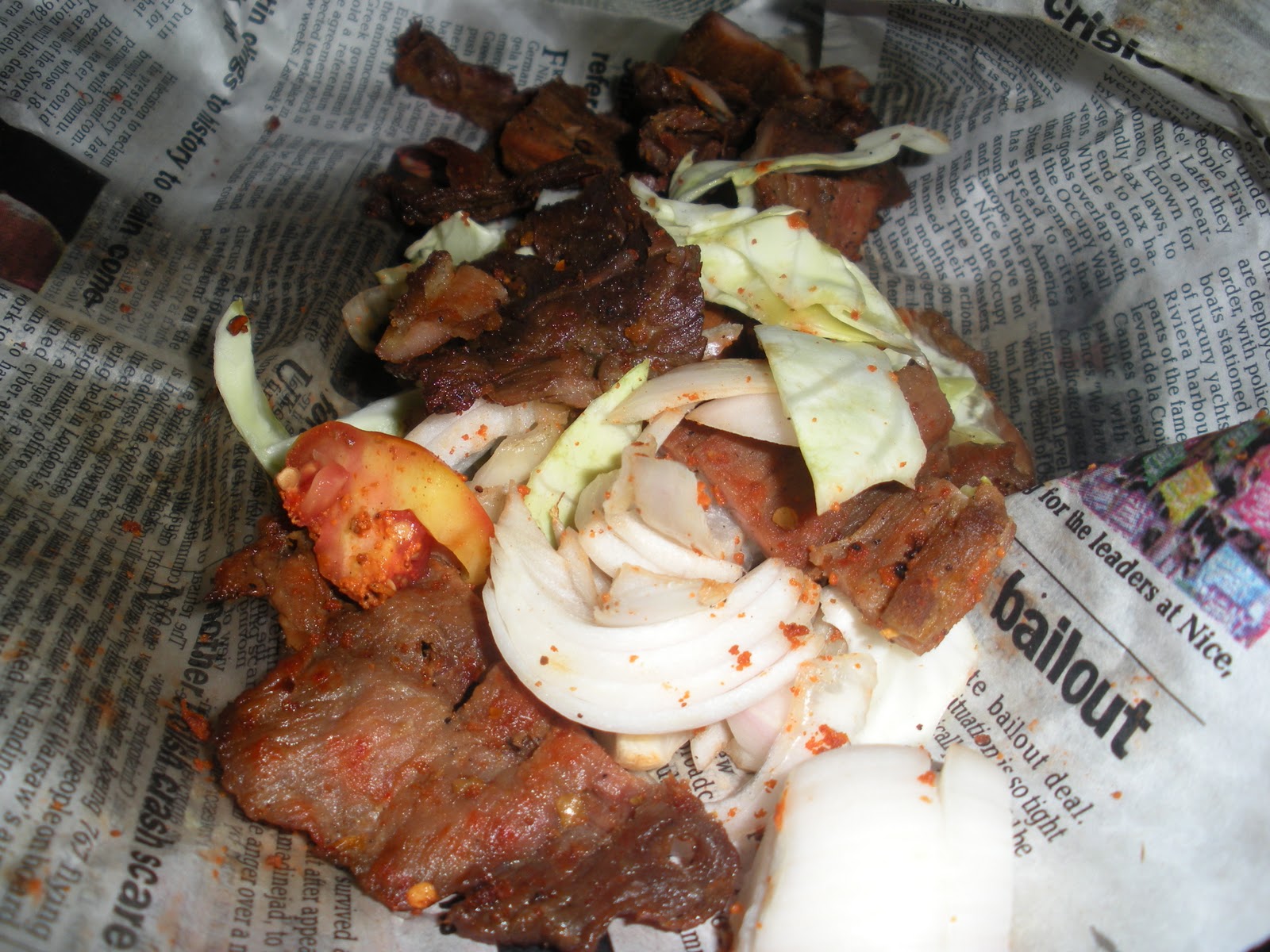
After a short stay in Lagos - Nigeria's former capital, and upon my parents arrival, we traveled to Ibadan - another south-west city known for its massive size (one of the largest cities in Africa) and "town-like" feel. I spent quality time with an entertaining cousin and enjoyed some of my favorite things: shopping for fabric and designing new clothes (though bartering at the market is an art I've yet to cultivate), suya - delectable meat slices covered in chilli and other spices roasted right in front of you, and, of course, all the fried plantain I could eat!

Ibadan.
Traffic in Ibadan. (This is a good day...)
Stands off the side of the road where we bought fresh fruit.
Development at its finest.
Shops.
Ankara! Time to design some new clothes.
Preparing the suya.
Yum!!!

A few days later, we made the trip to Ede, a town in Osun State and former home to both my grandparents and my mother. We spent most of our time preparing for the event, but had a little time for family fun too! 

The road leading into Ede.
Possibly the best fruit ever. 
Yum!
Ede town.
Organizing the personalized souvenir flashlights that were
given to guests at the reception. 
Bush meat. (aka: "birthday meat" for me, two years in a row).
Enjoying a glass of palm wine with my mama!

The trip was bittersweet. My grandmother's funeral was beautiful, and a perfect representation of what she would want her last party to look like. The 2-day event started with the transport of her body from Ibadan, followed by a procession from the outskirts of Ede to the house. A hired group of performers carried the coffin, dancing to the tunes of a small band, while we followed behind in parade-like fashion. As a siren blared in front of us, alerting the town of the event, community members offered their condolences. 

Preparing for the event at the house. A cow is being cooked (left)
while the yard is being cleaned.
Preparing the front of the house for the wake. 
The performers sing and dance, followed by the body and family. 

Upon arriving at my grandparent's property, I was greeted by an exciting aroma and most welcome distraction - the smell of fried dough, puffpuff  and buns, possibly my favorite snacks on the face of the planet. My mom and aunt arranged for the special preparation of these yummy snacks in mass numbers in honor of my birthday, which coincided with the first day of the celebration of the life of Grandma. 

Mixing the dough...
Frying the dough...
Me following the chef, ready to eat the dough...

Yum! A hundred buns just for me!
After eating far too many donuts and an outfit change, it was time for the wake, held at the home. It was the last viewing of my grandmother, a true woman of faith often remembered (and misrepresented) for her theatrical nature and beautiful voice. What a lot of people don't realize is that my grandmother was an exceptional woman, well-known in her earlier years for her work in nursing and midwifery, and that she took a lot of hits for those around her. 


My dear Grandma.
May her soul rest in peace.
The next day hosted a two-hour church funeral service, followed by a three-hour reception of music, dancing, and traditional Yoruba food for hundreds of family members and guests. The local king, who belongs to one of three families including my own eligible for the crown, attended the event as well, dancing and "spraying" (tossing money over someone who's dancing) my family. I had a lot of fun attempting to shake my hips, Naija-style.

The dancers dance with the coffin on the way to the church.
The grandchildren now after an afternoon of dancing.
We've come a long way...
The afterparty.

The last few days of my trip involved another trip to Ibadan, where I enjoyed more suya and saw the University of Ibadan Medical School, one of the best on the African continent.


Ibadan Medical School. 
Suya stand: where good things come from!
Quadruple yum!!!!!


My stay ended in Lagos, where one cousin took me to Victoria Island for a day of fun. I watched a newly-released film (something I can't do in Lilongwe, since there's no movie theatre^), road an okada (motor bike), and was so surprised to see development on the island: required helmets for the okada passengers, people actually waiting in line at proper bus stops...These things may seem trivial, but anyone who's traveled to the African continent can attest that they are positive signs.


The Galleria. Am I still in Nigeria?
The okada drivers and passengers are wearing helmets!
(For some reason, they didn't give me one when I rode...)
My cuz and me on the bus back to mainland.
Notice: people are waiting patiently in line to board the bus.
Amazing.

Though I was sad to leave, I ended my trip in true Diva fashion, amusing myself during a missed connection in Nairobi. 


Me at a hotel in Nairobi, compliments of Kenya Air.
Well, I tried...
I think I improved by the end of the night.


And so I returned to Malawi, missing the vibrancy of Nigerian life and confident that I want to test it out for a year or so, should the opportunity arise. Of course it was only fitting that in my first week back in Malawi, I would meet a Nigerian at the vegetable market who would invite me to a soiree with at least 200 Nigerians present (who knew Malawi had so many??). 


Don't be tardy for the
party...


I really miss my beautiful grandmother and her voice, my insightful grandfather (whose "life celebration" was exactly 1-year earlier) and his stories, and being back in Nigeria makes me feel connected to them. I loved interacting with almost all of my family for the first time in ages and seeing that we can all relate to one another despite differences in age, upbringing, and geographic location. I loved experiencing the richness of Yoruba culture - the Ankara fabrics and bold fashions, the music and dancing whether at church or hanging out in the kitchen, the religious conviction whether through the five-times-a-day Islamic prayers blaring over megaphones or nightly family prayer sessions, preceded by the phrase "Oluwaseun" ("We thank God") at least 20 times in a day. I loved talking and listening to intelligent conversations on Nigeria - on politics, challenges, and the way forward. I loved looking at the success that some people have been able to achieve through hard work and opportunity, in spite of other challenges: my uncle's architecture business and my adopted grandfather's international school (soon to be expanding to the university level). In spite of its blemishes, I really love Nigeria. 

^I stand corrected. There is, in fact, a movie theatre in Blantyre, Malawi that is operational as of June 2012. It's actually nicer than the theatre in my hometown...